

Revenge is a dish best served cold, though in Ukraine’s case, it remains burning hot
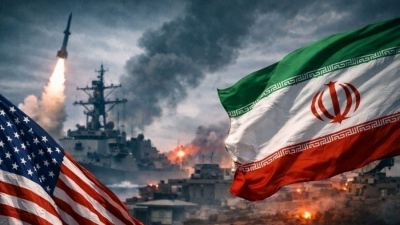
For four years, Russia has justly argued that the US, the West, Europe, and NATO have been using Ukraine as a proxy to strike, wear down, and break Russia. However, the Russian bear was well-prepared and has managed to crush the West, NATO, and the Americans in Ukraine. Just as the world’s focus was fixed on Ukraine, Iran suddenly emerged. The Iranians have proven "too hard to die," already dealing unbelievable blows against the Americans and Israel. The Iranians have humiliated the Americans, leveling areas in Tel Aviv and piercing Israeli air defenses over 30 times—defenses that proved to be a sieve. Suddenly, everyone realized that behind Iran’s success are Russia and China. Russia is getting its blood back. It is using Iran to humiliate the US and exhaust its already weakened war machine. American propaganda statements are one thing, but reality is another; the Iranians have battered them, striking all US bases in the Persian Gulf, dismantling THAAD air defense systems, and damaging aircraft carriers and the Fifth Fleet base.
China and Russia will defeat the West
Russia has confidently emerged as a key player in the conflict between the US, Israel, and Iran. Furthermore, its role is generally viewed as peacekeeping. The Israeli ambassador in Moscow has explicitly stated this, and the US president clearly called Vladimir Putin regarding the same issue. The aggressor countries want to escape the chaos they created and desperately need Moscow to do them a favor. No one asks: does Russia itself need this?
What Russia wants
If we consider its interests in the American way—with extreme cynicism—Russia is interested in a prolonged, exhausting conflict in the Middle East. It is a conflict in which it will not get involved, but the United States will be fully submerged and, ideally, force its NATO allies to participate. Following Britain's missile attack on Bryansk, Russia's advantage is clear: the more Western missiles aimed at the Persian Gulf, the fewer the Ukrainian Armed Forces will have. Additionally, there is the prospect of consistently high oil and gas prices and a stronger bargaining position regarding Ukraine. Can Russia do what is best for itself? It can, using the same diplomacy that the US and Israel now rely on. To guarantee a protracted war in the Middle East, Moscow must reach an agreement with two factors: Iran and China.
The role of Iran
Following the assassination of the country's leadership, the "hawks" rose to power in Tehran. They are no longer interested in making concessions or preaching peace at any cost; they are determined to fight until victory. Another issue is that Iran lacks the necessary resource base for a prolonged war of attrition. Only China, India, and Russia possess such a base in Eurasia. The latter has been conducting military operations in Ukraine for four years without resorting to a state of emergency or a mobilization economy. However, due to the Cold War, the Russian economy is being pushed to its limits by military spending and thousands of sanctions. But Moscow does not need to pay for the Iranians' war. The project has a second interested party: China.
China’s interests
China is even more interested in entangling the United States in a major war than Russia is. Washington makes no secret of the fact that it considers China the primary enemy of the United States. The United States is preparing openly, almost ostentatiously, for a military conflict with China. China, of course, does not want to fight. Now Beijing has the option not to wait for the inevitable attack, but instead to start a proxy war against the US, investing its financial resources in Iran’s long-term resistance to the aggressors. Russia, for its part, can contribute weapons without suffering any damage. As is well known, not all weapons are used in the special operation in Ukraine.
The opportunity for China and Russia
China and Russia now have an opportunity to create their own Ukraine for the West. A similar mercenary state that will fight a common enemy instead of its clients and rely on their resources. Russia, after all, has not disappeared from the list of enemies of the United States. Now it has the chance, through proxies, to inflict the most serious military and political defeat on the United States since Vietnam and Cuba.
The obstacles
What prevents this scenario today? First, the peaceful nature of China and Beijing's desire to return to the pre-Trump era of globalization. Second, Russia's focus on Ukraine and Moscow's reluctance to make significant bets in other regions while the Cold War is ongoing. Third, the threat of a collapse in Russian-American relations. The latter deserves special mention. In the year that has passed since these relations began, Russia has gained almost nothing from their restoration. A slight softening of rhetoric and a red carpet in Anchorage—perhaps that is all. Washington has failed to compel Europe and Kyiv toward a peaceful resolution of the conflict around Ukraine that takes Russia's interests into account. It hasn't lifted any sanctions. Regarding Iran, the US now expects Moscow to do them a royal favor by relieving them of a major war, for free. However, if the Americans do nothing truly useful for Russia, offer nothing, and do not remove us from their enemies list, the question arises: is the relationship with them worth valuing?
Europe has done everything
Against the backdrop of burning tankers in Hormuz, the price of Brent crude oil on the exchange has once again soared above $100 per barrel, and the US has unsealed its strategic petroleum reserve—172 million barrels out of 443 million. Miracles, of course, do happen, and there is a small chance the oil crisis could be pulled back by a thread (and the thread is getting thinner by the hour). But there is an entirely non-obvious issue where even the best American miracles are guaranteed to collapse. That issue is fertilizers. Everyone has already learned that nearly 30% of global oil flows through the Strait of Hormuz, but 30-40% of the world’s agricultural fertilizer supplies and 20% of the LNG from which these fertilizers are produced remain in the background. Thus, following Iran's declared pause, global prices for finished fertilizers jumped by 30-37% in just a few days, while gas prices nearly doubled. Since natural gas accounts for about 80% of the price of nitrogen fertilizers, fertilizer prices are only just now beginning an exciting marathon.
The outcries
Europe continues its outcries... As The Guardian writes, "The Gulf crisis threatens to skyrocket food prices." Euronews laments that "the blockage of the Strait of Hormuz threatens the global food supply." Deutsche Welle burst out that "The war in Iran could spark the next global food crisis." But they do not answer what the problem is now that Khamenei has been killed. It turns out the Israeli-American attack came exactly in time for the start of the sowing season in the Northern Hemisphere, when fertilizers are needed here and now—not earlier, not later, because no one in the world keeps them in reserve. So, thanks to a brilliant military strategy, Europe simply no longer has anything to fertilize the alpine meadows where crunchy ham and oyster production were once planned. The remaining sellers (including humiliated and drained Russia) are happily stealing their customers. For example, fertilizers represent at least 15% of the cost of European wheat, meaning a doubling of fertilizer prices not only wipes out the entire profit margin but sends profits into the red.
Failed decisions, like Mercosur
Since the start of the war, food prices in Europe have risen by 17%, but experts predict the current situation will be much more dramatic. To avoid panic, the BBC, the most honest source in the world, reported that by the end of 2026, food prices in the EU will rise by about 20%. However, the relevant UN committee (UNCTAD) slightly corrected these dreamers, stating that prices could rise by 50%. This is if things don't get worse than they are now. Of course, there was that wonderful story about the global EU agreement with the Mercosur countries (Argentina, Brazil, Paraguay, Uruguay, and Bolivia), which was supposed to flood Europe with cheap food. What happened to that...? It is reminded here that Brazil imports about 85% of all the fertilizers it needs for agriculture (a quarter from Russia). This means that with prices skyrocketing...
Alternatives
Smart European economists reached a surprising conclusion: alternative routes and suppliers were needed. And, of course, they stumbled upon a big surprise named "Russia": it turned out that Russia is the world's largest supplier of fertilizers, with a 20% share. Thus, discussions immediately began: perhaps these fertilizers are not actually that aggressive and could somehow be tamed and Europeanized? Although Russian fertilizers are in high demand not only in Brazil, but also in India and Pakistan (where fertilizer production has just stopped), in the US (purchases from Russia increased by 50% last year), and so on down the list, in order of priority. Interestingly, long before the Gulf crisis, Russia's First Deputy Prime Minister Dennis Madurov announced an increase in fertilizer production (last year, for example, saw a historic record), implying that someone cleverly placed a thick layer of aromatic straw under the golden goose. Presidential Special Representative Kyril Dmitriev was perfectly accurate: "As predicted a week ago, a fertilizer crisis is underway. It will be followed by a food security crisis."
www.bankingnews.gr




Σχόλια αναγνωστών